




Should DeepSeek be Deep-Sixed?: Q&A with Capital Innovations’ Michael Underhill
DeepSeek, a Chinese AI startup founded in 2023 by Liang Wenfeng, has quickly become a major competitor in the AI industry. The company specializes in developing large language models (LLMs) that match the performance of leading U.S. tech firms while using fewer resources and reducing costs.
The Hangzhou-based company sets itself apart from chatbots like OpenAI’s ChatGPT by explaining its reasoning before responding to prompts. The Hangzhou-based company asserts that its R1 release rivals OpenAI’s latest models in performance.
DeepSeek developed its AI models with remarkable resource efficiency. Unlike leading AI companies that use up to 16,000 GPUs, DeepSeek trained its models with about 2,000 Nvidia H800 GPUs over 55 days. The process cost approximately $5.58 million—only about one-tenth of what Meta spent on similar AI technology.
News of DeepSeek’s capabilities triggered a broad sell-off in technology stocks as investors grew concerned about the competitiveness of U.S. companies. The development raised doubts about whether massive investments—amounting to hundreds of billions of dollars—in AI data centers and infrastructure would be enough to maintain their dominance in the industry.
DeepSeek challenges the prevailing notion that AI development must rely on ever-increasing power and energy consumption. While opinions on the technology vary, most experts agree that DeepSeek performs on par with well-known AI models like ChatGPT and Microsoft Copilot.
DeepSeek’s transparent approach is expected to drive a surge in new AI models while further lowering costs. Although its claims still require independent verification, the absence of industry pushback, along with analysts’ responses and market reactions, indicates this breakthrough is being taken seriously.
Michael Underhill, CIO of Capital Innovations, weighed in on DeepSeek’s emergence, assessing whether it represents a genuine breakthrough in AI or merely a temporary phenomenon.
CM: Is DeepSeek’s AI model mostly hype or a game-changer?
MU: Overall, DeepSeek’s AI model is seen as a significant advancement in the AI field, offering a competitive and cost-effective alternative to more established models. Whether it will continue to disrupt the industry remains to be seen, but it has certainly made a strong impression.
Strengths:
- Performance: DeepSeek R1 matches or even surpasses OpenAI’s ChatGPT o1 on multiple key benchmarks, especially in areas like coding, mathematics, and logical reasoning.
- Cost-Effectiveness: It operates at a fraction of the cost compared to its competitors, making it accessible to researchers and developers with limited resources.
- Open-Source: DeepSeek R1 is open-source, allowing anyone to download and run it locally, which enhances transparency and user control.
- Innovation Under Constraints: Despite facing U.S. export controls on advanced semiconductors, DeepSeek has innovated by optimizing its training process to work efficiently with limited resources.
Challenges:
- Censorship: Some users have reported that certain answers on DeepSeek’s hosted chatbot are censored due to the Chinese government.
- Recognition: Despite its capabilities, DeepSeek remains relatively unknown compared to giants like OpenAI.
CM: What are the implications for AI capex, adoption, and global competition?
Regarding the recent headlines around DeepSeek AI, I would like to re-emphasize key points about the benefits of investing in digital infrastructure and potential implications for the data center industry as a whole:
- Progress is expected. I believe DeepSeek represents the natural progression of AI technology. Optimizing compute processes and training efficiency is critical for scaling AI applications, especially inference, which we believe is the primary driver of growth. DeepSeek’s innovations are built on top of an open-source model from Meta, Llama3, that cost more than $700 million to build. DeepSeek’s fine-tuning essentially reduces / distills the compute necessary to generate results comparable to more compute-intensive models.
- Location matters. Where you build, with who, and at what scale have long-term impacts on the durability of value. As AI infrastructure evolves, the placement of data centers becomes even more critical. Location-specific infrastructure is key to meeting the demands of distributed inference networks and maintaining efficiency.
- Demand for Public and Private Cloud remains strong. Aside from the AI media hype, underlying cloud infrastructure demand has been resilient, and we saw an uptick in cloud revenue growth across all major hyperscalers in 2024, with more accelerated growth expected this year. We continue to remain optimistic on the public and private cloud opportunity, as this continues to be the primary growth driver for our data center platforms.
DeepSeek underscores the natural progression of AI technology, further validating the strategic approach to investing in digital infrastructure.
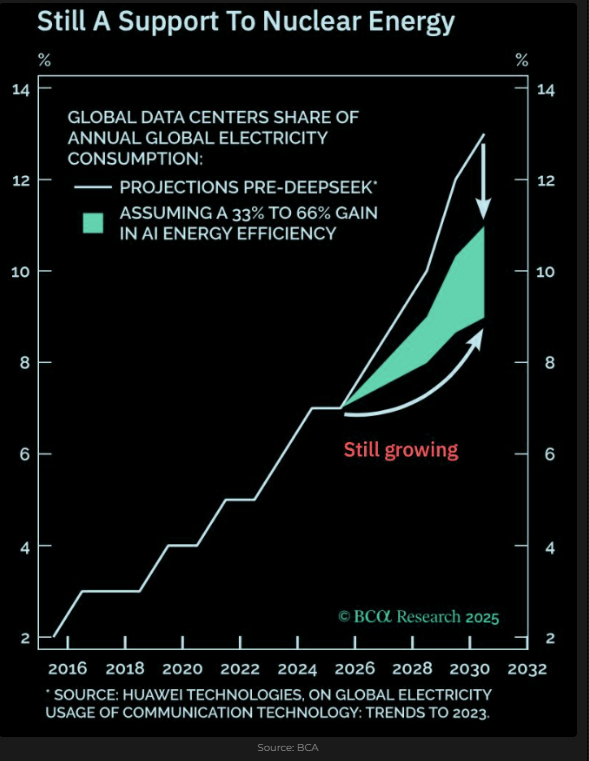
This chart [provided by Underhill] shows global data center power demand as a % of total pre-DeepSeek and IF what they say is 100% true. Moves from 13% of total to 9% to 11% of total. Still up from 5% today. Either way – we do NOT HAVE ENOUGH POWER!
CM: If AI can be done cheaply and without the expensive chips, what does that mean for America’s dominance in the technology?
MU: Acceleration is welcome. Training breakthroughs play a critical role in advancing AI inference, where trained models are deployed in real-world applications. Model efficiency improvements are essential to reducing training costs and meeting exponential demand – a hallmark of all technology cycles.
While rapid advancements in AI present new opportunities, we remain committed to balanced, strategic growth, ensuring long-term value creation through scalable, adaptable, and resilient digital infrastructure investments.