




Private Markets at an “Inflection Point”: Hamilton Lane
Hamilton Lane unveiled its annual private markets report today, painting a detailed picture of the global environment while highlighting the rising appeal of the evergreen market, which is increasingly attracting investors. Despite this long-term promise, the report flags short-term headwinds, including declines in fundraising, valuations, and near-term performance across certain segments.
Today, the global private markets investment manager released its 2025 Market Overview, spotlighting key investment opportunities and trends to monitor. The report identified credit, infrastructure, and secondaries as sectors “set up for success.” It also urged investors to channel funds into venture and growth opportunities as AI applications are expected to transform the business landscape, with many of these innovations emerging and maturing within the private markets, the report emphasized.
In the equities space, the report highlighted co-investment opportunities, noting that selectivity could unlock value for investors. Hamilton Lane pointed to the U.S. as a standout market, predicting it will be more appealing than any other region over the next four to five years. Additionally, the report flagged data and technology as a promising area for investment focus.
Short-term Performance
The report advised investors to keep an eye on short-term performance, observing that infrastructure and real estate have significantly outperformed their public market peers. Private credit has held steady, whereas private equity has lagged in recent results.
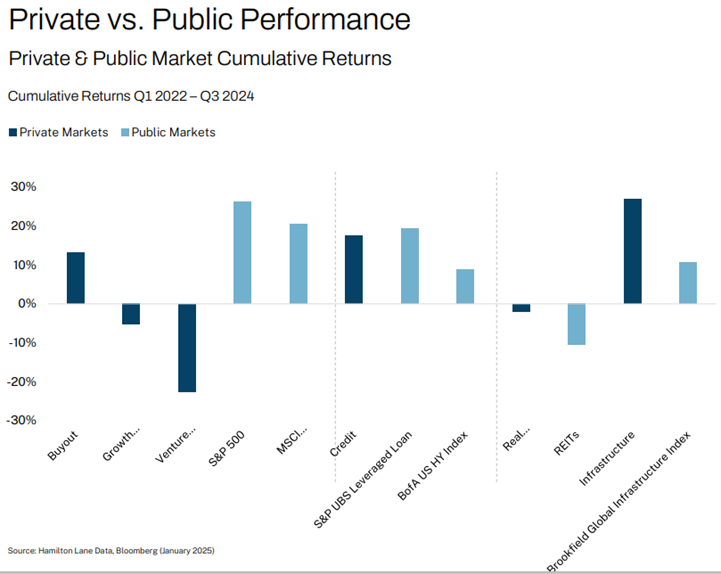
Although recent vintages are likely to encounter headwinds, the report emphasized that the choice of managers and assets will be pivotal—potentially more critical than in typical market environments. The public markets could prove to be the most significant determinant of future private equity performance. The report noted that private markets’ edge in outperformance diminishes when public markets deliver annualized returns exceeding 15% over a four-year stretch.
Hamilton Lane predicts that the next 12 months will usher in heightened fundraising difficulties. A significant uptick in exit activity is essential for fundraising momentum to recover, the report stated. Competition is intensifying, and the push to capture retail investors is accelerating. The firms thriving in today’s fundraising landscape are those leveraging technology and pioneering investment structures tailored to the needs of emerging investor groups.
The firm asserts that valuations from 18 months ago better captured true asset values, as public markets have since risen to align with private market levels. Yet, it cautions that this trend could reverse over the next 18 months, potentially driving public and private valuations in opposite directions.
Evergreen Funds
The report also outlined Hamilton Lane’s outlook for evergreen funds, which currently represent about 5% of the private markets landscape, equating to approximately $700 billion. The firm projects that, within a decade, evergreen funds could comprise at least 20% of total private markets. To achieve this, and assuming private markets maintain their historical 11% annual growth rate, evergreen funds would need to expand at nearly three times that pace—close to 30% per year.
The report pointed out that the U.S. high-net-worth channel currently allocates roughly 1% to evergreen structures. If this allocation increased to 5% or 6% over the next decade, it could drive evergreen funds to reach that projected 20% share of the total private markets landscape.
Hamilton Lane anticipates that over the next five years, evergreen funds will outpace the growth rate of public markets. The firm also foresees institutional investors playing a more prominent role in the evergreen arena. Additionally, it predicts that fees for evergreen funds will trend downward over time.
The report suggests that closed-end funds in specific strategies will diminish and largely fade away. Finally, the expansion of evergreen funds is expected to widen the gap in the private markets landscape, with the largest firms growing even bigger while smaller firms struggle to capture meaningful market share.
“…as we look at the year ahead, investors need to come to terms with the reality that there appears to be a recalibration in certain pockets of the global private markets, despite the fact that overall, the private markets are neutral right now,” said Mario Giannini, executive co-chairman and author of the Market Overview.