




Private Placement REIT Inflows Surge as Private Credit BDCs Face Redemption Friction
Private placement real estate investment trusts and business development companies reached a combined net asset value of $119.3 billion at June 30, rising 5.6% in the second quarter and 39% from a year earlier, according to Robert A. Stanger & Co.
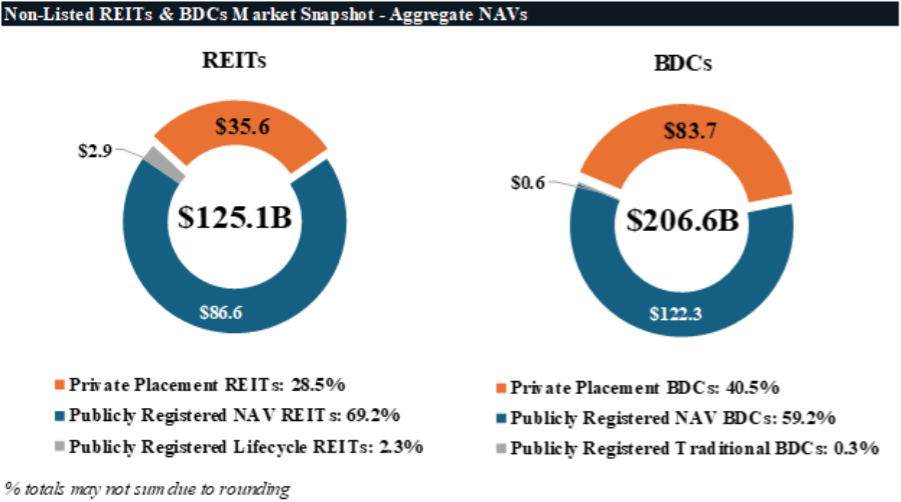
Private placement REITs accounted for 28.5% of the $125.1 billion non-listed REIT market, while private placement BDCs represented 40.5% of the $206.6 billion non-listed BDC market. The figures illustrate the expanding role of privately offered vehicles in providing individual and accredited investors access to illiquid real estate and private-credit assets.
Private placement REITs raised $4.8 billion during the first half of 2026, an 11.8% increase from a year earlier. Second-quarter fundraising totaled $2.5 billion, up 15.1% year over year and nearly 41% higher than funds raised by publicly registered non-listed REITs, Stanger said.
Performance also remained positive. Stanger’s Private NAV REIT Total Return Index gained 2.3% in the second quarter and 10.1% over the trailing 12 months. All 18 private placement NAV REITs in its quarterly return summary posted positive second-quarter returns, ranging from 1.1% to 4.5%.
“Capital continues to rotate toward hard assets with low obsolescence,” Stanger Chairman and Chief Executive Kevin T. Gannon said. “These vehicles have now outraised their publicly registered counterparts for seven consecutive quarters.”
Private placement BDCs faced a more difficult backdrop. They raised $6.9 billion in the first six months, down 18.5% from the first half of 2025. Second-quarter fundraising fell 34.3% year over year to $2.8 billion, the lowest quarterly amount since the second quarter of 2023.
Redemption pressure persisted. Among 26 funds with regular repurchase programs and at least $100 million in NAV, second-quarter repurchase requests equaled 6.7% of NAV. Sponsors satisfied 53% of requests, returning $1.3 billion to investors, while nine funds prorated withdrawals and an estimated $1.1 billion remained unmet.
Nontraded BDCs invest largely in private loans, which cannot always be sold quickly without reducing value. As a result, funds commonly limit quarterly repurchases to protect remaining shareholders and maintain portfolio stability.
Early third-quarter data offered limited evidence of easing pressure. Seven funds reported requests equal to 4.5% of NAV, compared with 7.8% for the same funds in the second quarter. Four met all requests, while one fund with about $146 million in NAV met only 7%.
“The private placement BDC market is following the same broad pattern we reported in the publicly registered market this quarter, though the magnitude is different,” Gannon added. “Fundraising has contracted, redemption demand is elevated, and proration is doing exactly what it was built to do — balancing liquidity for investors who want out against protection for those who remain.
Connect Money is spotlighting rising stars who have made a valuable contribution to the alternative investments industry. Based on your nomination, we will recognize professionals who have significantly influenced both the workplace and community. The deadline is September 9. Click here to submit your nominations and help us highlight the next generation of leaders.

