DJIA38904.04 307.06
S&P 5005204.34 57.13
NASDAQ16248.52 199.44
Russell 20002060.10 8.70
German DAX18163.94 -238.49
FTSE 1007911.16 -64.73
CAC 408061.31 -90.24
EuroStoxx 505013.35 -57.20
Nikkei 22538992.08 -781.06
Hang Seng16723.92 -1.18
Shanghai Comp3069.30 -5.66
KOSPI2714.21 -27.79
Bloomberg Comm IDX102.90 0.64
WTI Crude-fut91.17 0.01
Brent Crude-fut86.57 1.15
Natural Gas1.79 0.00
Gasoline-fut2.79 -0.01
Gold-fut2345.40 33.50
Silver-fut27.50 0.46
Platinum-fut940.60 -5.50
Palladium-fut1007.40 -23.60
Copper-fut423.60 1.85
Aluminum-spot1815.00 0.00
Coffee-fut212.50 5.75
Soybeans-fut1185.00 5.00
Wheat-fut567.25 11.00
Bitcoin67976.00 304.00
Ethereum USD3328.10 56.27
Litecoin98.71 0.69
Dogecoin0.18 0.00
EUR/USD1.0862 0.0007
USD/JPY151.72 -0.02
GBP/USD1.2678 0.0016
USD/CHF0.9044 -0.0014
USD IDX104.28 0.08
US 10-Yr TR4.4 0.091
GER 10-Yr TR2.406 0.007
UK 10-Yr TR4.064 -0.005
JAP 10-Yr TR0.771 -0.004
Fed Funds5.5 0
SOFR5.32 0
High-rise commercial buildings

Sub Markets

Topics

Economy  + Central Bank Watch  + Markets  | 
U.S. Banks Clear Fed Stress Test With Capital to Spare

U.S. Banks Clear Fed Stress Test With Capital to Spare

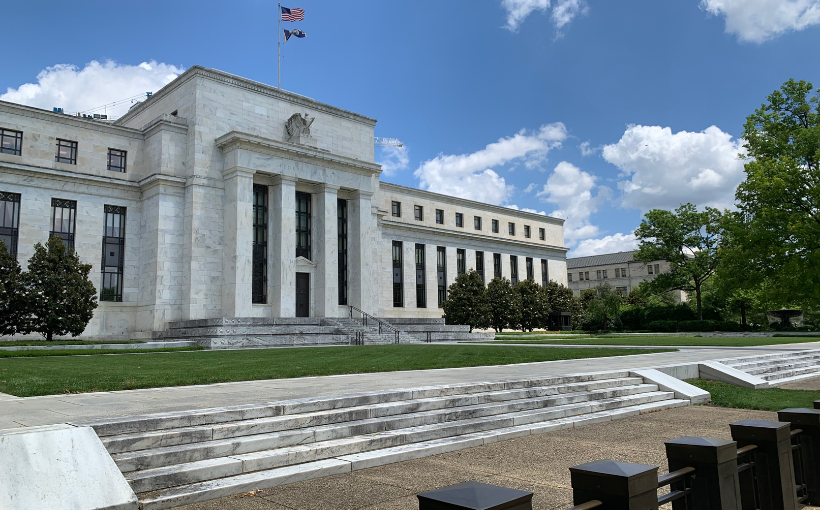
The nation’s largest banks remain well capitalized and capable of continuing to lend through a severe economic downturn, according to the Federal Reserve’s 2026 annual bank stress test, which found all 32 institutions maintained capital levels above regulatory minimums despite absorbing more than $708 billion in projected loan losses.

The hypothetical scenario modeled a deep global recession featuring a 39% decline in commercial real estate prices, a 30% drop in home prices, unemployment rising to 10%, and a sharp contraction in economic activity. Under those assumptions, banks’ aggregate common equity tier 1 (CET1) capital ratio declined by 1.6 percentage points but remained comfortably above minimum requirements.

“Today’s results underscore the strength of the banking system,” said Federal Reserve Vice Chair for Supervision Michelle Bowman. She added that the Fed is working to improve the transparency and accountability of the stress-testing process and will incorporate public feedback into future models.

The central bank noted that this year’s results will not affect large-bank capital requirements. Existing requirements will remain in place through 2027, when updated stress-testing models reflecting public input are scheduled to take effect.

The Fed attributed the projected capital decline primarily to higher loan losses resulting from larger loan balances and more severe assumptions for certain asset classes, as well as lower unrealized gains on securities due to smaller hypothetical declines in interest rates. Those pressures were partially offset by stronger projected net interest income, reflecting improved bank earnings and a higher interest-rate environment.

Credit card lending represented the largest source of projected losses at approximately $200 billion, followed by $160 billion in commercial and industrial loan losses and roughly $75 billion tied to commercial real estate exposure.

Connect

Inside The Story

Federal Reserve stress test

About Joe Palmisano

Joe Palmisano is Editorial Director for Connect Money, where he brings nearly three decades experience of market insights as a financial journalist, analyst and senior portfolio manager for leading financial publications, advisory firms, and hedge funds. In his role as Editorial Director, Joe is responsible for the selection of content and creation of daily business news covering the financial markets, including Alternative Assets, Direct Investment and Financial Advisory services. Before joining Connect Money, Joe was a financial journalist for the Wall Street Journal, regularly publishing feature stories and trend pieces on the foreign exchange, global fixed income and equity markets. Joe parlayed his experience as a financial journalist into roles as a Senior Research Analyst and Portfolio Manager, writing daily and weekly market analysis and managing a FX and US equity portfolio. Joe was also a contributing writer for industry magazines and publications, including SFO Magazine and the CMT Association. Joe earned a B.S.B.A. in Finance from The American University. He holds the Chartered Market Technician (CMT) designation and is a member of the CFA Institute.

New call-to-action