




Powering Up Infrastructure: Q&A with Hamilton Lane’s Brent Burnett
“Infrastructure continues to see significant capital formation behind the mega trends of energy transition, digitization and supply chain and logistical optimization.”
Alternative investments can exhibit greater volatility than traditional investments, yet they often demonstrate low correlations with or deviate from conventional asset classes. Investors may encounter growing challenges in achieving consistent income-driven returns and alpha solely through public markets, especially given inflation’s “bumpy path” down to the Federal Reserve’s 2% goal and a still relatively elevated interest rate environment. On both counts, alternative assets are viable options.
Brent Burnett, Head of Infrastructure and Real Assets at Conshohocken, PA-based global investment manager Hamilton Lane, discussed the current appetite for infrastructure assets, the launch of the firm’s two infrastructure evergreen funds, the increasing sizes of transactions, and what trends will drive infrastructure in the years ahead.
CM: Why inflation-resistant assets now and why infrastructure?
BB: Having just come off the most inflationary environment that the developed world has seen for some time, this is top of mind for investors today. Infrastructure offers strong inflation protection benefits, as the contract structures of infrastructure assets usually have inflation-linked escalators that ensure that revenues rise in line with inflation. The replacement costs of infrastructure assets also have strong inflation correlation benefits, so in an inflationary environment, the value of infrastructure assets can also rise.
CM: Tell us about your two newly launched infrastructure evergreen funds.
BB: Our newly launched infrastructure evergreen funds offer expanded access to private market infrastructure investments to institutional and individual investors around the world. The Hamilton Lane Global Private Infrastructure Fund (“HLGPI”) is available to qualified investors, including high-net-worth investors in EMEA, Australia, Canada, Latin America and Southeast Asia. There is a version of this fund available to U.S. clients, including HNW investors and their wealth advisors, which is a continuously offered closed-end investment vehicle registered under the Securities Act of 1933 and the Investment Company Act of 1940 (“40 Act”).
Both funds seek to provide compelling risk-adjusted returns with strong downside protection via a globally diversified portfolio of infrastructure assets. The Funds are total return strategies, targeting both capital appreciation and income, designed to provide exposure to an institutional-quality, global portfolio of infrastructure assets through a single investment while also offering investor flexibility via a low minimum investment, attractive economics and partial liquidity.
CM: Infrastructure transactions are getting larger. What’s behind that trend?
BB: Infrastructure capital flows have grown by an annual CAGR of ~26% since 1999, growing from $5.0B in 1999 to over $1.3T today. The interest in infrastructure assets makes a lot of sense. This is an asset class that has offered total returns approaching those seen in other areas of private markets, but with better downside protection and less return dispersion, a measure of volatility.
Infrastructure returns can also offer an attractive mix of income and capital appreciation while being uncorrelated from both traditional and alternative asset types. As investor interest has accelerated for infrastructure, fund sizes have continued to get larger. Whereas 10 years ago, the largest infrastructure funds were raising $5-8B in total fund sizes, today those large cap funds are approaching $25-$30B.
More capital flows and larger fund sizes means intense competition for assets, especially in the large cap space. This is one of the reasons why it’s not uncommon to see large cap deals transact at purchase price multiples that are 25-30% than small-to-mid cap deals.
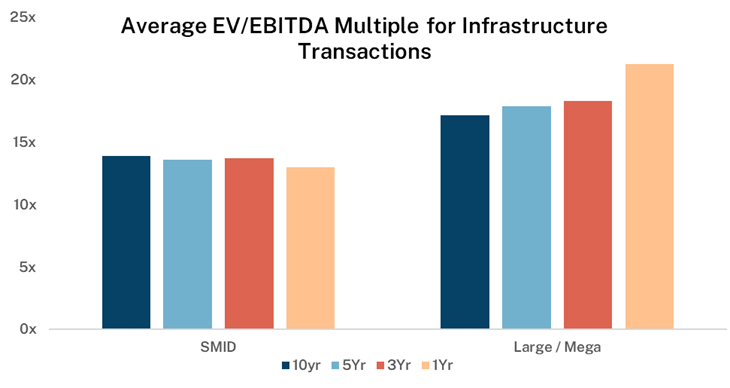
Data pulled from: Infrastructure messaging, Building Economic Opportunity with Private Infrastructure, Infra COTW
CM: Which thematic trends will drive infrastructure assets over the next few years?
BB: Infrastructure continues to see significant capital formation behind the mega trends of energy transition, digitization and supply chain and logistical optimization. Renewable energy standards, cost competitiveness with traditional sources of generation and strong state and federal incentives continue to drive new capacity expansion in all forms of renewable generation. The rollout of AI and more intense data applications and interconnectivity of devices is driving the need for more data centers, fiber rollout and tower infrastructure. We believe these themes will continue to drive capital formation for years to come.
We are also focused on a few sub-themes within infrastructure. First, we continue to favor the small-to-mid cap space over the large cap space. As mentioned, we are seeing better entry point valuations, better asset-level liquidity and better opportunities for value creation in those small-to-mid-sized assets.
We also like infrastructure secondaries. As the investment in infrastructure has grown, so has the NAV value of high-quality assets held in the secondary market. Like private equity, more infrastructure investors and general partners are looking to the secondary market as a tool to manage portfolio exposures or effectuate partial asset sales and we believe our information advantages are critical to pricing these assets in the secondary market.
Another sub-sector within infrastructure where we continue to find opportunities is in the waste and environmental space. Vertically integrated waste management companies can have strong infrastructure characteristics and are well-positioned to grow both organically and through M&A activity in more fragmented markets.